
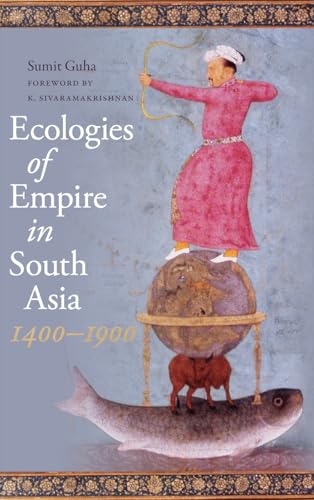
Ecologies of empire in South Asia, 1400-1900 / Sumit Guha.
Series: Culture, place, and naturePublication details: Ranikhet ; Permanent Black, 2023.Description: xvi, 243 pages ; 24 cmISBN:- 9780295751481
- 9780295751498
- 9788178246772
- 304.2095409 GUH
| Cover image | Item type | Current library | Home library | Collection | Shelving location | Call number | Materials specified | Vol info | URL | Copy number | Status | Notes | Date due | Barcode | Item holds | Item hold queue priority | Course reserves | |
|---|---|---|---|---|---|---|---|---|---|---|---|---|---|---|---|---|---|---|
 Books |
ATREE Library General Stacks | Non-fiction | 304.2095409 GUH (Browse shelf(Opens below)) | Available | 5890 |
Inequality, complexity, and ecology -- South Asia in the imperial gaze -- Imperial gaze, lordly grasp -- The village and its inhabitants -- Lands of resistance, terrains of refuge -- Colonialism, disarmament, and the closing of the forest frontier.
"By focusing on the human gaze, or how people interpret their relationship with land, Sumit Guha traces the longue durée of the political ecology of empire in South Asia during the age of empires. This relationship is in most sharp relief when comparing the exploitative and extractive practices of the Mughal Empire and the industrial British Raj as these imperial regimes encountered a large and old agrarian society. While scholars of South Asia regularly dwell on the destructive nature of British policies in South Asia, Guha integrates the cultural turn in environmental studies with the complex imperial rivalries that defined South Asia from the fifteenth through the mid-twentieth century to demonstrate how land use is defined through matrices of competing geographic expertise, too often in service of distant courts and environmental degradation"--
There are no comments on this title.